
New research reinforces decades of ergonomic best practices—and international workplace standards—on the importance of managing repetitive work and prolonged static postures.
For decades, ergonomists have encouraged office employees to take frequent, brief breaks from computer work. The reasoning is well established: repetitive movements, sustained postures, and insufficient recovery opportunities contribute to unnecessary fatigue, discomfort, and musculoskeletal risks.
Yet many employees still spend hours at their computers with remarkably little movement.
Now, new research published in September 2026 provides new physiological evidence supporting this longstanding recommendation. Combined with other recent scientific findings and established workplace standards, it strengthens the case for making microbreaks an essential component of workplace ergonomics programs.
What Happens After 25 Minutes of Sitting?
A September 2026 study published in npj Exercise Medicine and Health investigated how muscle activity changes during prolonged sitting. ¹
Researchers analyzed 7,684 sitting periods involving 84 adults using specialized shorts equipped with electromyography (EMG) sensors to directly measure thigh-muscle activity during everyday activities.
The findings were revealing. As sitting periods grew longer, detectable muscle activity progressively declined, approaching minimal levels after approximately 25 minutes. Participants who typically sat for shorter periods also exhibited more muscle activity while seated than those who habitually sat longer.
The researchers estimated that interrupting prolonged sitting approximately every 25 minutes could potentially produce the equivalent of 1.5 additional hours of detectable muscle activity during sitting across a 10-hour seated day.
The study offers important physiological evidence about prolonged inactivity.
The takeaway is not that something suddenly happens at minute 25. It is that the body responds to how long we remain inactive—and regular movement matters significantly.
Why Microbreaks Reinforce Established Ergonomic Principles
Traditional office ergonomics emphasizes proper workstation configuration: adjustable seating, monitor positioning, keyboard placement, and neutral working postures.
These are essential, but even an optimally configured workstation cannot eliminate the risks associated with prolonged static postures and repetitive activity.
The National Institute for Occupational Safety and Health (NIOSH) identifies repetition and sustained postures among important musculoskeletal risk factors. Maintaining a position for extended periods can contribute to muscle fatigue, even when that position is relatively neutral. ²
Similarly, OSHA recommends short, frequent breaks from repetitive computer work, including standing, stretching, and moving for approximately five minutes each hour. ³
This distinction is fundamental: Workstation adjustments improve how we mechanically work. Microbreaks manage how long we continue the same physical activity without recovery.
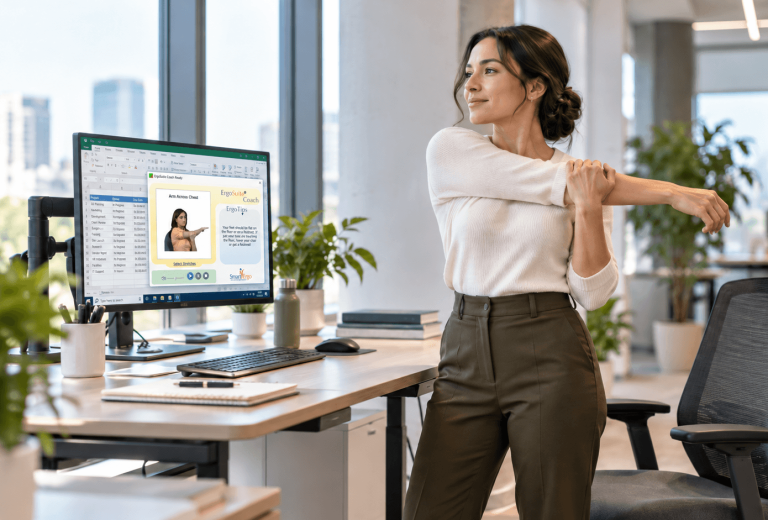
For employees performing extensive keyboard and mouse work, microbreaks can interrupt repetitive upper-extremity activity while providing opportunities to change neck, shoulder, back, and lower-body postures.
Importantly, simply standing while continuing to type or mouse does not necessarily relieve repetitive upper-extremity demands. Effective recovery should address both posture and activity.
Germany’s Workplace Standard: An Established Precedent
Germany provides a compelling example of how these principles have been incorporated into recognized occupational health practices.
Under Germany’s Workplace Ordinance (Arbeitsstättenverordnung), screen-based work must be regularly broken up through other activities or recovery periods. ⁴
In July 2024, Germany issued Technical Rule ASR A6, Bildschirmarbeit (Screen Work), providing more detailed guidance. ⁵
The standard emphasizes several important principles:
- Screen-based work should be broken up regularly through task changes or appropriate recovery periods.
- Several shorter recovery periods are preferable to fewer longer breaks of equivalent total duration.
- Approximately five minutes of recovery per hour of uninterrupted screen work is recognized as an established practice.
- Workstations should facilitate movement and minimize prolonged static loading.
The five-minute recommendation is guidance within the technical rule, not a universal requirement prescribing precisely five minutes for every worker.
Nevertheless, the underlying principle is significant: regular brief breaks during prolonged screen work are an established occupational health practice, not merely an optional workplace wellness initiative.
Similar recommendations appear in OSHA guidance and materials from the German Social Accident Insurance organization (DGUV). ³ ⁶
Reduced fatigue and improved well-being
The September 2026 muscle-activity study adds to a growing body of research examining the benefits of interrupting prolonged sitting and repetitive work.
A 2022 systematic review and meta-analysis published in PLOS ONE evaluated 22 independent study samples involving 2,335 participants. ⁷
Researchers found that microbreaks produced statistically significant reductions in fatigue and improvements in cognition and vigor.
The findings reinforce the value of brief recovery periods for employee well-being.
Measurable metabolic benefits
A 2023 randomized crossover study published in Medicine & Science in Sports & Exercise investigated different combinations of walking-break duration and frequency. ⁸
Researchers found that walking for five minutes every 30 minutes significantly reduced post-meal glucose responses compared with uninterrupted sitting. Several walking-break schedules also improved systolic blood pressure.
The study demonstrated that brief interruptions to sitting can produce measurable physiological benefits.
Strategically timed computer reminders change behavior
A June 2025 systematic review and meta-analysis examined 18 randomized studies involving 1,164 office workers. ⁹
Computer-based break prompts were associated with approximately:
- 12.5 fewer minutes of sitting per workday
- 1,030 additional steps per day
These findings confirm that strategically timed digital reminders can help translate ergonomic recommendations into measurable changes in employee behavior.
Structured movement breaks show promise
A 2026 randomized controlled trial investigated an eight-week office exercise program incorporating five-minute exercise breaks each hour. ¹⁰
The researchers reported reductions in sitting time, increased standing, and improvements in reported musculoskeletal discomfort, including neck discomfort, among participants completing the relevant assessments.
The findings support the value of structured workplace movement programs.
Taken together, these studies reinforce the benefits of managing prolonged sitting, providing regular recovery opportunities, reducing fatigue, and encouraging healthier work patterns.
They do not establish that any one break schedule will prevent every musculoskeletal disorder, but they add meaningful scientific support to longstanding ergonomic recommendations.
Making Microbreaks Part of the Modern Workday
Today’s employees often move from virtual meetings to email, spreadsheets, reports, and other computer-intensive activities with few natural opportunities for physical recovery.
Even employees with perfectly adjusted workstations can accumulate hours of uninterrupted keyboarding, mousing, and sitting.
An effective workplace ergonomics program should therefore encourage several complementary practices:
- Interrupt prolonged sitting: Stand, walk, or change posture regularly.
- Break up repetitive activity: Periodically stop intensive keyboard and mouse work.
- Introduce task variety: Alternate computer-intensive work with activities involving different physical demands.
- Encourage active recovery: Use short breaks for light movement or stretching when appropriate.
- Provide timely reminders: Help employees remember breaks without creating excessive interruptions.
- Maintain flexibility: Adapt recovery periods to the task, individual needs, and ergonomic risk assessment.
The 2026 muscle-activity study highlights the value of managing sitting approximately every 25 minutes. Germany’s ASR A6 recognizes five minutes of recovery per hour of uninterrupted screen work as an established practice. Other studies demonstrate benefits from different patterns of brief movement.
These recommendations are complementary rather than contradictory.
There is no universally established microbreak schedule that is optimal for every employee or every outcome because each worker’s day is unique to their workflows and personal circumstances during that particular day. The objective is to provide regular movement, variation, and meaningful recovery opportunities throughout the workday customized for each worker.
Technology-supported reminders, employee education, and organizational encouragement can help make these behaviors routine rather than dependent on employees remembering to take breaks during demanding workdays.
A Small Investment in a Healthier Workday
The newest research does not fundamentally change what ergonomists have known and recommended for decades.
Instead, it provides additional scientific support for those recommendations.
We now have more direct evidence of declining muscle activity during prolonged sitting, measurable physiological benefits from interrupting sedentary time, documented improvements in fatigue, and research showing that digital prompts can help employees establish healthier more productive habits.
Alongside established guidance from OSHA, NIOSH, and Germany’s workplace safety framework, these findings reinforce a central principle: Effective ergonomics is not just about how a workstation is configured. It is also about how employees use it throughout the day.
Microbreaks cannot eliminate every ergonomic risk. But helping employees avoid hours of uninterrupted repetition and static posture is a practical, evidence-informed component of a healthier workplace.
And the body of research provides compelling reasons to make that longstanding best practice part of every workday.
Studies and Sources Referenced Above
- Brakenridge, C. J., Lamberg, S., Rantalainen, T., et al. (2026). When we sit: textile electromyography identifies decreasing muscle activity and implications for metabolic health. npj Exercise Medicine and Health, 1, Article 7.
- National Institute for Occupational Safety and Health (NIOSH). (2024). Step 1: Identify Risk Factors.” CDC. Guidance identifying repetition, static postures, and related musculoskeletal risk factors. U.S. Centers For Disease Control.
- U.S. Occupational Safety and Health Administration (OSHA). Workstations eTool: Work Process and Recognition.” Guidance on repetition, static postures, task variation, and microbreaks. U.S. OSHA.
- Federal Republic of Germany. Arbeitsstättenverordnung (Workplace Ordinance), Annex, Section 6.1(2). Requirements for regular interruptions to display-screen work. Federal Republic of Germany.
- Bundesanstalt für Arbeitsschutz und Arbeitsmedizin (BAuA). (2024). Bildschirmarbeit. July 2024, Sections 5.3 and 6.3.9. Technical guidance on recovery periods and working postures. BAuA.
- Deutsche Gesetzliche Unfallversicherung. (2019). DGUV Information 215-410: Bildschirm- und Büroarbeitsplätze – Leitfaden für die Gestaltung. Guidance on work organization and recovery periods.. DGUV.
- Albulescu, P., Macsinga, I., Rusu, A., Sulea, C., Bodnaru, A., & Tulbure, B. T. (2022). Give me a break!’ A systematic review and meta-analysis on the efficacy of micro-breaks for increasing well-being and performance. PLOS ONE, 17(8), e0272460.
- Duran, A. T., Friel, C. P., Serafini, M. A., Ensari, I., Cheung, Y. K., & Diaz, K. M. (2023). Breaking Up Prolonged Sitting to Improve Cardiometabolic Risk: Dose–Response Analysis of a Randomized Crossover Trial. Medicine & Science in Sports & Exercise, 55(5), 847–855.
- Leppe-Zamora, J., Ramos-Fuster, S., Muñoz-Monari, B., Roa-Alcaino, S., & Sarmiento, O. L. (2025). The effect of computer prompt in breaks of sedentary behaviour among office workers: a systematic review and meta-analysis. International Journal of Behavioral Nutrition and Physical Activity, 22, Article 75.
- Putsa, B., Jalayondeja, C., Jalayondeja, W., et al. (2026). Effects of Breaking Up Prolonged Sitting with an Office-Based Exercise Program on Sitting Time, Physical Activity, Musculoskeletal Discomfort, and Stress in Office Workers: A Randomized Controlled Trial. Journal of Health Science and Medical Research.