
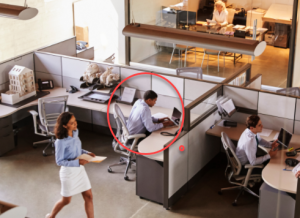
When most people think about office ergonomics, they think about equipment: an adjustable chair, correctly positioned monitors, keyboard and mouse or perhaps a sit-stand desk. Those things have great potential to help. But they are only part of the equation – and their value potential is wasted if they’re not used properly on a regular basis.
A well-designed workstation creates the opportunity for good ergonomics. Employee behavior determines whether that opportunity actually produces results.
Before diving into the data, consider asking two questions.
First, ask someone in your HR, Benefits or Finance team: What do we spend annually on healthcare for our office workforce?
- For perspective, Mercer, a business of Marsh, reports that the average total cost of employer-sponsored health benefits is expected to exceed $18,500 per employee in 2026. For an organization with only 1,000 covered office employees, that represents more than $18.5 million in annual health benefit costs. Mercer also notes that health-benefit cost growth is running much faster than general inflation. 1
- It’s little wonder that a 2026 Mercer survey found roughly three-fourths of CFOs consider healthcare costs at least a top-five operating-cost concern, with one-third ranking them among their top three. ¹
Then, one last question: What would even a 5% or 10% reduction in preventable healthcare costs be worth?
In perspective, for an organization with just 1,000 office employees and the $18.5 million annual health benefit cost for those employees, 5% represents $925,000 and 10% represents $1.85 million every year. What if you have 2,000, 3,000, 4,000 or 5,000+ employees on computers?
Those percentages are fact-based illustrations, which demonstrate the scale of the financial opportunity when preventable health risks can be reduced.
The Business Group on Health recently reported some important survey results: 4
- Healthcare costs have increased by more than 50% from 2017-2025. Although employees bear a significant financial burden, Employers have absorbed the majority of those increases.
- Employers are facing steeper year-over-year healthcare cost increases, a development made clear after actual healthcare costs significantly exceeded employer forecasts for the second year in a row. This calls for employers to act with greater urgency than in the past.
- While employers have always sought to adopt sustainable cost-containment approaches, the current unfavorable environment is a call to action for bolder moves to address healthcare costs.
The underlying opportunity is neither complicated nor hypothetical.
Healthcare spend includes enormous costs associated with chronic conditions, many of which have important modifiable risk factors.
Why Behavioral Ergonomics?
You may not realize it, but you definitely already “live the answer” yourself every day if you drive a car.
For anyone with even the slightest question about the vital importance of behavioral support, consider this quick simple test:
Imagine your son or daughter is now old enough to drive and you’re helping provide their first car. There are two identical cars available although one has no reminder system if the driver forgets to buckle up; and the other provides a warning light and audible reminder until the belt is fastened.
Which car would you give your child?
The answer is obvious. The safety equipment is identical—the only difference is behavioral support which helps ensure it is actually used.
The principle is well documented. Research cited by the U.S. National Highway Traffic Safety Administration (NHTSA) found that persistent audio-visual seat-belt reminders increased belt use by approximately 30%–34% compared with a short intermittent reminder. Timely for our article, after decades of experience and data review, NHTSA has further strengthened the federal seat-belt reminder standard, with compliance with the enhanced front-seat requirements required beginning on the date of this article: September 1, 2026. ²
Behavioral Office Ergonomics Works The Same Way
Office ergonomics follows the same principle as detailed above: equipment creates the potential; behavioral support helps turn that potential into everyday behavior.
Providing good adjustable equipment creates the potential for better outcomes. Behavioral support helps ensure that potential is actually realized day after day.
There is another important lesson in effective reminder systems: the objective is not simply to produce more warnings. It is to provide timely behavioral support when it is needed.
ErgoSuite applies this same principle to office ergonomics—providing coaching when an employee’s work behavior falls outside ergonomic best-practice thresholds. As healthier behaviors develop and become habits, coaching is needed less frequently, while remaining available when old habits resurface.
An adjustable chair cannot deliver its full value if it is not used properly. A sit-stand workstation provides little benefit if it stays in one position all day. And even an excellent $2,000 workstation cannot mitigate the health risks associated with prolonged static postures (unmanaged sitting).
Put simply: Behavior is the mechanism by which ergonomic design produces outcomes.
From Workstation Setup to Daily Behavior
When an ergonomist works personally with an employee, the professional does much more than reposition equipment. They explain why changes matter and coach the employee on how to use the workstation properly.
That personal attention is extremely valuable, but no organization can economically provide continuous human one-on-one ergonomic coaching to every employee.
Meanwhile, ergonomic risk accumulates every day – often long before discomfort becomes serious enough for an employee to request assistance.
The opportunity is therefore to move ergonomics further upstream, helping employees recognize and correct risk-producing behaviors before discomfort becomes persistent.
Today’s increasingly digital workplace makes that especially important. Employees often become absorbed in their work for long periods, frequently unaware of how long they have remained in the same posture.
The Health Issue Is Bigger and Much More Costly To Your Organization Than Discomfort
The consequences of prolonged sedentary work extend beyond traditional neck, shoulder, back and wrist discomfort.
MD Anderson Cancer Center, the #1 rated Cancer Research Hospital System in the U.S., notes evidence associating extended periods of sitting with increased risk of colorectal, endometrial and lung cancers, as well as obesity, diabetes, cardiovascular disease and premature death. MD Anderson explains that the unbroken nature of sitting is the primary problem, as it prevents our bodies from naturally “clearing” pro-inflammatory markers (read referenced article at MD Anderson below). 3
This does not mean that office ergonomics alone prevents cancer or other chronic diseases. It does mean that prolonged sedentary behavior is a modifiable risk factor – and the workday represents thousands of hours each year in which healthier behavior can be achieved.
That matters financially as well. Business Group on Health reported in 2026 that employers face a projected median 9% upward healthcare cost trend, falling to 7.6% only after plan changes, during the highest three-year stretch of healthcare cost growth in more than a decade. It identifies cancer, musculoskeletal and cardiovascular conditions among persistent cost drivers and emphasizes proactive health and lifestyle strategies to help mitigate long-term costs. 4
For your business case, a 2026 study of 7,147 adults strengthens that connection further: work-related sitting was associated with higher annual primary healthcare costs, while leisure-time sitting showed no independent association. In one occupational-sitting category, adjusted annual primary-care costs were approximately 20% higher than among those reporting the least sitting at work. 5
For cost-conscious employers, prevention does not necessarily require another expensive benefit program. It can also mean reducing manageable health risks during the thousands of hours employees already spend working each year.
Best Practice Is Moving in the Same Direction
Current national ergonomic standards and guidance are evolving along with the research. Germany’s DIN EN ISO 9241-5:2026-01, which replaced its 1999 edition, updates workstation and postural national requirements to reflect modern working practices, including postures between sitting and standing and revised provisions for ease of workstation adjustment. 6
Germany’s January 2026 DGUV Rule 115-401 for Office Operations is even more explicit, encouraging dynamic sitting, sit-stand work and movement during the workday—and noting that alternating among sitting, standing and walking is better than simply alternating sitting and standing. 7
The direction is clear: modern ergonomics increasingly combines good workstation design with posture variation, movement and employee behavior.
Research Increasingly Supports Design + Behavior
Recent research again reinforces the importance of combining physical workstation improvements with behavioral support.
A 2025 Lancet Public Health umbrella review examined 36 systematic reviews covering 214 separate studies. Sit-to-stand workstations produced some of the largest reductions in sedentary time—but adding psychosocial and behavioral strategies increased those reductions by as much as 33%. 8
The equipment worked. Adding behavioral support made it work substantially better.
That is an important distinction.
Providing an employee with the ability to change posture is not the same as helping the employee actually change posture.
Technology can help bridge that gap. A 2025 systematic review and meta-analysis of 18 studies involving 1,164 office workers found that computer prompts significantly reduced workplace sitting and increased physical activity by approximately 1,030 steps per workday. 9
And a 2026 randomized controlled trial found that behaviorally designed ergonomics education improved correct working posture and exercise behaviors while reducing ergonomic risk and pain-related complaints. 10
Taken together, the evidence is straightforward: knowing what to do matters. Helping employees actually do it consistently is what makes ergonomics deliver high results and ROI and become sustainable.
Training Is Important, Coaching Makes It Stick
An employee can complete excellent ergonomic training and understand exactly how to adjust a chair, position a monitor and incorporate movement into the workday.
But days, weeks or months later, circumstances change. A different chair appears. A second monitor is added. The employee begins working from home several days each week. Employees use shared workstations. Deadlines lead to hours of uninterrupted computer work.
Knowledge has not disappeared. Daily habits have simply taken over.
That is why effective modern Office Ergonomics in 2026 combines:
- Assess and educate. Help employees understand their own workstation, risk factors and simple corrective actions while generating useful organizational risk metrics.
- Support healthy behavior. Timely reminders, coaching and feedback help employees maintain proper workstation use, posture variation and Power Breaks.
- Provide adjustable workspaces. Employees need equipment that allows them to change posture and position throughout the day.
- Measure and improve. Use assessments, participation data, behavioral measures and outcomes to identify emerging risks and continuously improve the program.
The objective is not to replace ergonomists. It is, instead, to extend their knowledge and best practices to far more employees while helping identify those who genuinely require professional attention.
Ergonomic design sets the stage; employee behavior determines what happens on it.
When employees are trained, supported and given timely feedback, ergonomic equipment and best practices are far more likely to be used consistently—helping reduce risk, fatigue and discomfort while supporting healthier, more productive work.
Studies and Sources Referenced Above
- Mercer. (2026). The CFO Perspective on Health: 2026 Survey Results Mercer.
- U.S. National Highway Traffic Safety Administration (NHTSA). (2025). Federal Motor Vehicle Safety Standards; Occupant Crash Protection, Seat Belt Reminder Systems, Controls and Displays. U.S. National Highway Traffic Safety Administration.
- MD Anderson Staff, Medically Reviewed (2025). Can sitting for too long really increase your cancer risk? MD Anderson Cancer Center.
- Business Group on Health Report. (2026). Taking Action on Health Care Costs: A Business Group on Health View. and
2026 Employer Health Care Strategy Survey. The Business Group on Health. - Akhavan Rad, S., Leinonen, A.-M., Korpelainen, R., et al. (2026). Association of Context-Specific Sitting Time with Healthcare Costs at Midlife: The Northern Finland Birth Cohort 1966 Study. Medicine & Science in Sports & Exercise.
- DIN. (2026). Ergonomics of human-system interaction — Part 5: Workstation layout and postural requirements. DIN EN ISO 9241-5:2026-01.
- Deutsche Gesetzliche Unfallversicherung (DGUV). (2026). DGUV — Rule 115-401 Office Operations. Deutsche Gesetzliche Unfallversicherung.
- Rouyard, T., Yoda, E., Akksilp, K., et al. (2025). Effects of workplace interventions on sedentary behaviour and physical activity: an umbrella review with meta-analyses and narrative synthesis. The Lancet Public Health.
- Leppe-Zamora, J., Ramos-Fuster, S., Muñoz-Monari, B., et al. (2025). The effect of computer prompt in breaks of sedentary behaviour among office workers: a systematic review and meta-analysis. International Journal of Behavioral Nutrition and Physical Activity.
- Ozturk, C.P., Baskurt, F., & Kolcu, G. (2026). Evaluation of online transtheoretical model-based ergonomics education for office workers. Work.
Terminology: Where scientific studies use terms such as “interrupted sedentary behavior,” “activity breaks,” “microbreaks,” or “breaking up prolonged sitting,” your intrepid author uses the employer-friendly term Power Breaks to describe brief periods of posture change, stretching or movement integrated into productive work.