
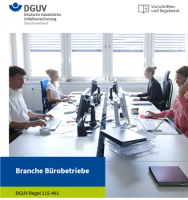
Germany’s 2026-updated Office Ergonomics Standards have been published, which signal widespread recognition of the strong interconnections between Physical Ergonomics, Behavioral Ergonomics, Digital Fatigue and Worker Health. Essentially, Germany’s office ergonomics framework underwent one of its most significant updates in years.
Rather than simply revising desk and chair requirements, the German Social Accident Insurance (DGUV) agency expanded the guidance to treat physical and behavioral ergonomics, mental health, work organization, hybrid work, indoor climate, and digital fatigue as one integrated occupational health system.
Specifically in standards for the office environment, the term Physical Ergonomics encompasses:
- workstation fit: chair, desk, monitor, keyboard, mouse, footrest
- contact stress: hard desk edges, armrests, tools pressing into the body
At the same time, specifically in standards for the office environment, the term Behavioral Ergonomics encompasses:
- posture: neck, back, shoulders, arms, wrists, hips, legs
- repetition: repeated keyboarding, mouse use, scanning, reaching
- awkward positions: twisting, bending, reaching, raised shoulders
- movement and recovery: breaks, posture changes, sit-stand variation
Not surprisingly, prolonged static postures are now treated as a health hazard which signals how regulations and standards are evolving as they eventually catch up to the latest peer-reviewed scientific research. The successful solutioning focus is clearly on “what we know today” versus “what we advised years ago”.
Unlike 1990’s guidance focusing mainly on furniture and equipment, the modern guidance emphasizes employee behaviors:
- movement throughout the day
- frequent brief recovery breaks during work
- varying posture while working
- reducing prolonged sitting
- encouraging sit-stand working where appropriate (when actually used as intended)
The evolved emphasis is on dynamic working, not merely providing ergonomic furniture.
The changes come in response to alarming trends in Germany’s workforce health in recent years. Based on troves of government Disability Pension data, psychological conditions accounted for 16.7% of all sick-leave days, making them the third most common cause of absenteeism.
Even more concerning, psychological conditions, including stress, now represent 42% of all disability pensions in Germany, highlighting the long-term impact and costs of unmanaged workplace stress and Digital Fatigue.
These figures have a part in what’s prompted regulators, occupational health experts, and employers to reevaluate workplace risk factors. The result is a regulatory framework that recognizes the strong connections between Psychosocial Stress, Digital Fatigue, Physical and Behavioral Ergonomics, and Employee Wellbeing for office workers.
Of interest, notable attention in the 2026 German Office Ergonomics Standards is placed on Digital Fatigue which the Standards refer to as Technostress.
You can read the 2026 Office Ergonomics Standards PDF, published by the German government, at: “DGUV Rule 115-401 (Office Operations)“. This is the new 2026 edition (78 pages), which supersedes the May 2018 version. Unfortunately, it’s too soon for an English version but you probably have access to AI which can translate it into English for you in a minute or two.
German employers with office workers are expected to align their ergonomics programs and workplace practices with the 2026 guidance as part of demonstrating compliance with existing occupational safety obligations.
So why should an ergonomist in Sheboygan Wisconsin, London England, Lagos Nigeria, or anywhere else outside of Germany, be interested in German office workers and standards? The answer is self-evident. “The physiology of office workers around the globe is the same – no matter what country they work in.“
Expanding Beyond German Borders
Your intrepid author has been re-reviewing a major article by EU-OSHA: “Musculoskeletal disorders and prolonged static sitting“. It’s not surprising that with musculoskeletal disorders entrenched as the highest injury and healthcare spend for the office, employers continue working to mitigate well-understood ergonomic risks facing computer-users working on-site, remotely and in hybrid-mode.
Given the time elapsed since the article’s publishing, where people have been working in prolonged static postures for all or a percentage of their work days and are working under significantly increased stress as organizations around the globe reduce pandemic-bloated workforces, the message is ever more urgent today.
Some of the very clearly written points in the highly-informative and fact-filled article include:
- Due to the use of computers and other similar devices, many workers are tied to their desks for prolonged periods of time. Prolonged sitting is an increasing occupational health risk in the workplace.
- Sedentary behaviour leads to various health risks. Besides musculoskeletal disorders (MSDs), prolonged sitting may also lead to health risks in other domains, such as diabetes, heart- and vascular disease, depression and even mortality.
- This is why it is considered important to change between postures as much as possible. For the best health and safety outcome, workers should be able to adopt a variety of body positions: preferably workers should be able to vary between sitting, standing and moving about.
- Where previously the nature of work required workers to move around in the office, e.g. to put something in a filing cabinet, now many tasks just require a mouse click. Over the past decades, a shift in the activity profile of workers has been observed with a tendency for physical activity to be replaced by cognitive work.
- Prolonged sitting is a risk factor for various health problems. The musculoskeletal health effects related to prolonged static sitting are low back pain and neck- shoulder complaints. Recent studies confirm that back pain within the last 24 hours shows a clear trend connected to static sitting behaviour.
- Sitting time at work is associated with neck–shoulder pain. An unfavourable working posture can lead to an increased muscle tension in the neck and shoulders. When neck and shoulder muscles are "overstrained", the pressure on the blood vessels will increase, meaning that the blood vessels towards the arm can become partially pinched. The result can be a painful neck, shoulder muscles and cold hands due to reduced blood flow, or a combination of these.
- Prolonged sitting is also associated with a spectrum of other health risks, including diminished cardiovascular health (including vascular function, circulation and blood pressure problems and heart disease), cancer, diabetes, weight gain, metabolic syndromes, higher risk of psychological distress, muscle degeneration, osteoporosis and a higher rate of mortality.
Beyond the main points of the article, specific mitigation guidance included:
- Avoid prolonged periods of sitting – aim to get up and take short micro breaks at least every 20 - 30 minutes.
- Always get up after 2 hours of sitting for at least 10 minutes.
- Be a work organisation and workplace culture that promotes active and dynamic ways of working.
- Provide training and instruction to create awareness, including exercises during work.
- Reinforce a correct working posture including correct workplace design and adjustment possibilities of the workplace, use the adjustment possibilities of your chair.
For the studious reader here who is interested in detailed explanations of how and why prolonged static postures lead to musculoskeletal disorders, the article is a must-read.
Successful forward-looking employers embrace Continuous Improvement as a Health and Safety Best Practice, enabling them to adapt to the continuously evolving Riskscape which prominently includes challenges due to relentlessly increasing healthcare costs and the pressure from above to reduce expenses.
You’ve hired terrific intelligent people as your computer-using employees. Even outfitted with the best furniture and equipment available today, however, it’s well-understood that “how an employee uses their workstation” (their behavior) will largely dictate their comfort, injury risk and productivity.
Simplified through metaphor, the office workstation is the stage while office workers are the actors.
It would be ideal to hire legions of ergonomists on staff who would live with every employee at their on-site office and home-based office today. They would teach employees key actionable Best Practices of computer ergonomics and help them assess and tune-up their hybrid and at-home work area. Thereafter, they would personally coach employees to learn to automatically move about and stretch periodically while they work in neutral postures, without having to think about it.
It’s obviously cost-prohibitive to hire professionals to personally coach every employee.
Instead, the most successful model, a “Do It Yourself” Model (DIY), is called for which invites employees to “share in the responsibility” of having a comfortable, safe and productive work environment through habituating well-established Best Practices.
That sharing of responsibility is a naturally symbiotic partnership required for employee ownership of their time working on the computer. Further, leveraging a DIY Model identifies complex risks early-on which can be resolved by ergonomics professionals.
In the case of people working on computers in onsite offices, shared-workstation offices and home-based offices, these Best Practice behaviors are (1) working in neutral postures and (2) providing brief recovery time during work coupled with movement designed to break up extended static postures.
Case Study 24 – 595,260,706 Observations – Consistent Results
This study’s data (below), reminds us of an earlier study by a university research team at an Insurance Brokerage Risk Management firm where they measured the impact of an earlier version of ErgoSuite on their employees using computers at least one hour each day.
Below, we’re looking at an actual ErgoSuite Enterprise chart where we’ve chosen to utilize Least Squares Linear Regression Lines (trend lines) to reliably model extensive underlying data’s movement over time.
This chart summarizes a comprehensive twelve-month research project, analyzing 595,260,706 keystrokes and mousing seconds belonging to a large population of knowledge workers including a diverse spectrum of job functions.
The live chart illustrates the achievable efficacy of DIY Behavioral Office Ergonomics for reducing fatigue, increasing comfort, effecting actual behavior change.
When we properly empower employees, who can then meaningfully share in the responsibility of their comfort and safety and learn to automatically pace themselves while working in more neutral postures, then they will fatigue at a slower rate, be more comfortable, work at a lower risk profile, have fewer injuries and consume less healthcare services.
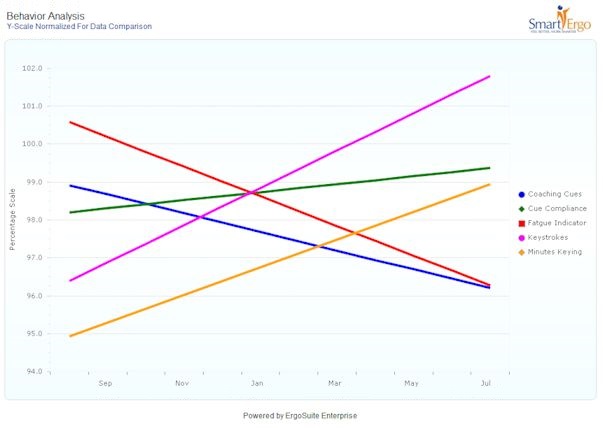
In respect of the data and outstanding results, we’ll keep the commentary brief and simply report on the details here:
- A key understanding here (discussed in more detail below) is that the behavioral coaching cues are only required when an employee’s “recovery time as a function of duration and repetition” is inadequate (high risk). As they learn to automatically pace themselves then they are coached less by ErgoSuite Coach which knows this.
- In this analysis, ErgoSuite is modeling actual data and not forecasting future trends. Future Trend Analysis is done in other ErgoSuite tools.
- Of course, raw data is never as smooth as the trend lines because it ebbs and flows over time traversing seasonality such as reduced activity during holidays, however, the trends above are clear and reliable. Linear regression is an invaluable tool widely used throughout mathematics and business for modeling trends from complex data sets.
- Each metric in the chart is indexed to its initial value, for comparability, showing its trend (growth) over the period. For example, seeing the metric Fatigue decrease from an index of 100.5 down to 96.3 confirms that objectively quantified Fatigue has been reduced by 4.2% over the period after taking into consideration the entire ordered data set and not just the beginning and ending values. It does not mean that the employee population’s fatigue was over 100% at the start.
- The overall Behavioral Coaching Cue Compliance for this specific population of employees was solidly within the 90%-100% range throughout the period (see chart).
- The average number of data observations ‘per employee’ underlying ‘each’ trend line is more than 350,000 over the twelve-month period.
- This employee population spans the spectrum of low, medium and higher computer-usage. In addition, we know from other collected live data analyses that when employees develop new good ergonomic behaviors at work, these learned behaviors carry on after work when using the computer at home.
The only way these new behaviors become sustainable is when the employee learns to change and improve their behavior where they can automatically pace themselves, stretch and increase daily movement without having to focus on it. This is no different from how a musician benefits from the coaching of a metronome while developing their rhythm. This is the ideal time to positively reinforce neutral postures and awareness training.
When employees automate good ergonomic behaviors including working in neutral postures, providing brief recovery time during work with movement and gentle stretching, they’re more comfortable and work at a lower risk profile – and they are measurably more productive.

Other hazards such as optics, contact stress and environment issues should be periodically addressed when identified, however, when you read every country’s regulations and laws regarding office ergonomics, you clearly see the huge prominence of the two key employee behaviors – posture and pacing.