


In 2026, Digital Fatigue is no longer just a wellbeing concern or a productivity issue. It has emerged as a material cybersecurity risk which directly affects how safely and effectively general employees interact with digital systems and security protocols.
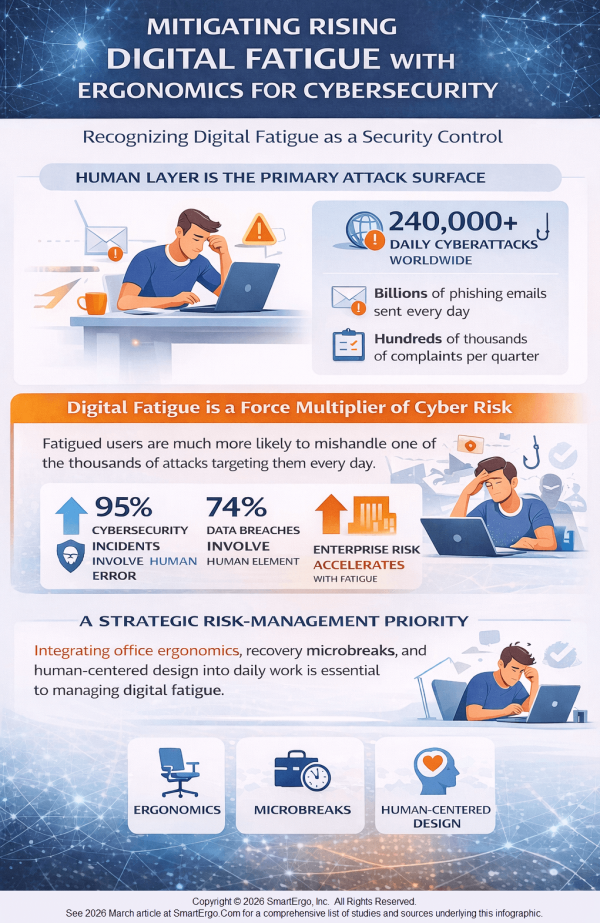
Security industry research reports that human error plays a dominant role in cybersecurity incidents. More than 74% of data breaches involve human error, including phishing, credential misuse, and social engineering.¹ Beyond data breaches, up to 95% of overall cybersecurity incidents involve human error.²
All organizations follow the best practices of securing infrastructure and training all workers on their critical role in cybersecurity practices, however, what happens when the worker is cognitively fatigued?
Among the first things safety professionals learn at the start of their career is how Office Ergonomics is used to professionally identify, assess, and mitigate knowledge worker fatigue. Safety professionals of any experience level, however, are probably not aware of how Digital Fatigue has become the top and most successful cyber-attack vector exploited by bad actors over recent years (see infographic below).1, 2
As your intrepid author, let’s do a deep dive into the hard facts and examine their sources and references.
What Is Digital Fatigue?
Digital Fatigue refers to the mental, physical, and cognitive exhaustion caused by prolonged and intensive interaction with digital technologies.³ It manifests as reduced concentration, eye strain, musculoskeletal discomfort, irritability, slower reaction times, and diminished decision-making capacity.
Unlike short-term tiredness, Digital Fatigue is cumulative and systemic, driven by multitasking, video meetings, authentication prompts, unmanaged time at the computer without recovery microbreaks and information overload.⁴
The condition of Digital Fatigue is not new to 2026.
- The World Health Organization (WHO) officially recognized the syndrome in 2019 as an “occupational phenomenon that influences worker health status“.
- The International Ergonomics Association (IEA) has been actively involved in addressing Digital Fatigue through various initiatives and guidelines for years. IEA’s definition and scope of ergonomics (adopted in 2000) explicitly include mental processes, workload, decision making, and human–system interaction, which encompass the kinds of cognitive strain central to Digital Fatigue discussions.
- The European Agency for Safety and Health at Work (EU-OSHA) leads research, guidance, and campaigns on how digital technologies affect workers’ safety and health, including mental workload and psychosocial risks of digitalization. Their work explores how digital tools, automation, prolonged static postures, lack of recovery time, and constant connectivity can create new risk factors – the very conditions that contribute to Digital Fatigue.
Framing The Scale of The Risk
For knowledge workers (anyone using a computer for work), office ergonomics has traditionally focused on reducing known risks where the consequences of risk exposure affect individual employees – musculoskeletal strain, repetitive strain injuries, and cumulative discomfort. While negative outcomes impact at the individual level (discomfort, musculoskeletal disorders, etc…), their aggregate impacts over time carry significant financial and operational costs for organizations.
Digital Fatigue dramatically expands that equation. When unmanaged Digital Fatigue intersects with cybersecurity, however, now the consequences of a single lapse extend far beyond one employee. In a single fatigued moment, clicking a malicious email link, approving a fraudulent request, or overlooking a warning, can easily trigger a data breach, ransomware disaster, or operational shutdown affecting the entire organization from one single moment.
The potential fallout is not limited to reputational damage. Organizations may face temporary business interruption, regulatory scrutiny, contractual penalties, remediation costs, and millions of dollars in follow-on expenses.
- For cybersecurity professionals, when general employees’ Digital Fatigue leads to an inadvertent failure of following security protocols, organizations are left vulnerable to cyber threats that could otherwise have been prevented – and that they thought they had prevented with training.
- For safety professionals, understanding Digital Fatigue and how to mitigate it is essential. Protecting cognitive capacity is no longer solely about preventing injury or improving comfort – it is about safeguarding operational continuity and enterprise resilience.
- For executive leadership, this reframes Digital Fatigue from a safety, health and wellness issue to a mission-critical matter of enterprise resilience and risk governance.
Digital Fatigue represents a unique convergence between office ergonomics and cybersecurity.
Comparatively, within industrial ergonomics the consequences of risk exposure typically affect one worker or a defined group performing a task.
In contrast, within office ergonomics, Digital Fatigue introduces a systemic vulnerability. When faced with a malicious email or website link, a fraudulent request, or security warning, one single cognitive failure by one general employee can easily cascade into an organization-wide incapacitating event.
Email systems are constantly improving and catching many phishing emails, however, bad actors have started using AI in their businesses also and the results are remarkably sophisticated attacks.
The U.S. National Institute of Standards and Technology (NIST) defines Phishing as “A digital form of social engineering that uses authentic-looking – but bogus – e-mails to request information from users or direct them to a fake Web site that requests information.“
Digital Fatigue, Office Ergonomics and Cybersecurity Intersect in Mission Critical Ways
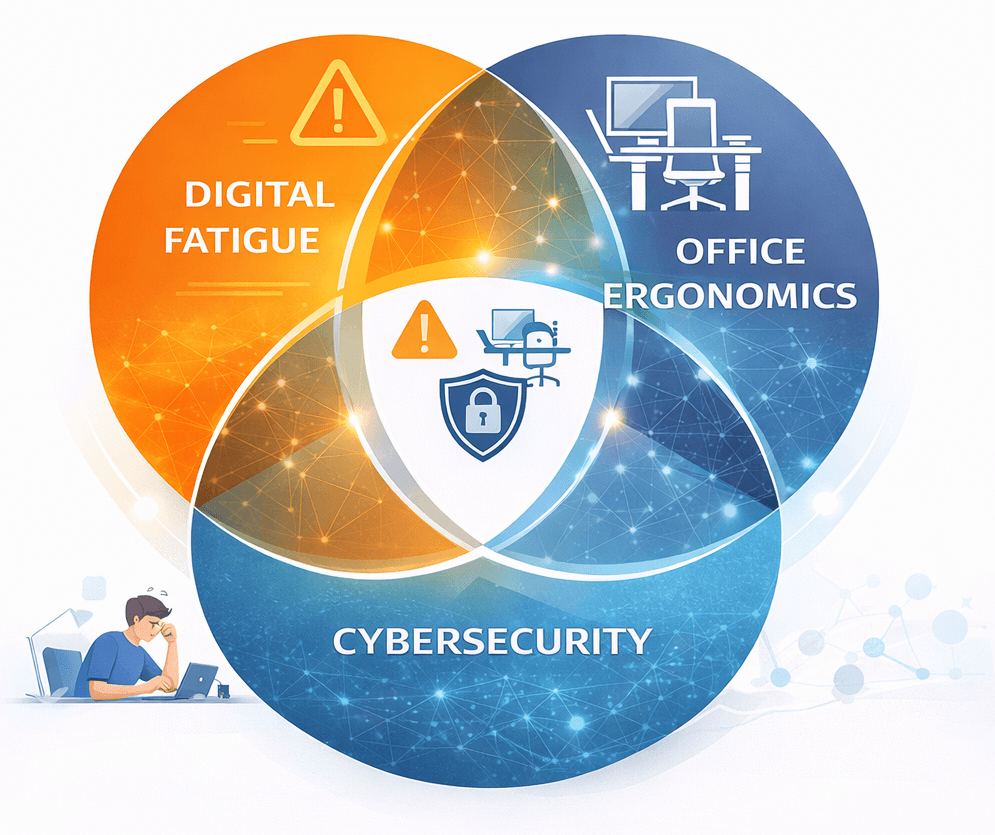
For safety and risk professionals, this understanding requires an important expansion of workplace hazard recognition.
Digital Fatigue should be evaluated in the same rigorous way safety teams assess physical strain, repetitive motion, or extended shift work.
Prolonged screen exposure, cognitive overload, and discomfort are risk factors that affect judgment, reaction time, and error rates. Protecting employee cognitive capacity is not just a wellness initiative – it is a safety and risk-management imperative today.
As organizations rely more heavily on cloud platforms, AI-assisted tools, continuous monitoring, and always-on collaboration, knowledge workers are spending unprecedented amounts of time engaging with screens, complex workflows, and discomfort. Left unmanaged, this sustained digital exposure, left unmanaged, is quietly eroding attention, judgment, and resilience – the very human capabilities that both safety systems and cybersecurity defenses depend on.
Beyond that, an informative article “How Digital Fatigue Turns Employees into Cyber Risks“, reports “The danger of digital fatigue in modern workplaces isn’t merely a productivity concern—it is a ticking time bomb for cybersecurity.¹²
Why Digital Fatigue Is a Major Cybersecurity Issue in 2026
- Fatigue increases human error. Research and industry analysis show that fatigued employees are more likely to make mistakes, including clicking phishing links, mis-handling sensitive data, and overlooking security warnings.⁵
- Security fatigue leads to disengagement. Security fatigue occurs when users are overwhelmed by repeated alerts, password changes, MFA prompts, and compliance tasks.⁶ Over time, this can lead to alert desensitization or bypassing security controls.
- Cognitive overload reduces threat awareness. Human-factors research demonstrates that fatigue reduces vigilance and the ability to detect anomalies or assess risk in complex systems.⁷
- Digital fatigue in the global cyber-risk landscape. The World Economic Forum’s Global Cybersecurity Outlook Davos Switzerland 2026 frames cybersecurity as a socio-technical challenge, emphasizing the role of human limitations under growing system complexity, screen time and overload.⁸
Imperative: Recognizing Digital Fatigue as a Security Control
Every day, organizations are targeted by many thousands of ransomware, phishing, and social engineering attacks, most of which are designed to exploit human behavior rather than technical flaws.
The term “attack” is simply defined as one effort by a bad actor targeting an organization which is often comprised of phishing and social engineering attempts. According to trend reporting, these many thousands of cyberattacks occur every single day worldwide, including sophisticated high-risk phishing attempts, malware delivery, social engineering, and more.13
Phishing remains one of the most common and costly attack vectors, with billions of phishing emails sent daily and hundreds of thousands recorded as complaints quarterly.14
Cyber attacks are not static. They are growing in number, automation, and complexity, driven by AI adoption by attackers, expanded attack surfaces, and persistent threat activity. As a result, organizations today face significantly more frequent and sophisticated attacks than in prior years, making human-factor risk management increasingly critical.
In cybersecurity today, the human layer has grown into the primary attack surface. In this environment, Digital Fatigue is not a secondary wellness concern; it is a force multiplier of cyber risk. At scale, fatigue of general employees using computers converts routine attack volume into enterprise-level exposure.
Digital Fatigue, today in 2026, sits at the intersection of well-being, performance, and cybersecurity. Addressing it through office ergonomics including recovery microbreaks and human-centered design is a strategic risk-management priority.
The Role of Ergonomics in Reducing Digital Fatigue
Ergonomic design supports sustained attention and reduces strain that accelerates fatigue when enabled by employee behavior.⁹ Employee behaviors including maintaining proper workstation setup, neutral posture body alignment, recovery microbreaks and lighting reduce cognitive and physical load.
A 2024 scoping literature review found consistent evidence linking prolonged digital work to reduced productivity, impaired concentration, increased error rates, and negative well-being outcomes.¹¹
Industry analysis shows that fatigued employees are more vulnerable to phishing and credential theft, particularly under high cognitive load.¹²
Microbreaks are the well-established Fatigue Countermeasure. Human-factors guidance identifies regular brief short breaks as an effective control for managing fatigue, maintaining vigilance, and reducing error rates.¹⁰
Digital Fatigue should therefore be treated as a human cyber-risk condition, not merely a discomfort issue.
Studies and Sources Referenced Above
- Fast Company. Data Disasters and Human Error. Prevent human error with strategies that work. Verizon Data Breach Investigations Report.
- James Coker. 95% of cybersecurity incidents involve human error. InfoSecurity Magazine.
- Dr Laura Bradshaw Always on, always tired: Why digital fatigue is an emerging OSH risk. IOSH.
- Filiz Mizrak, et al. Digital detox: exploring the impact of cybersecurity fatigue on employee productivity and mental health. Springer Nature.
- Dune Research Team. How Employee Fatigue Drives Human Error in Cybersecurity. Dune Security.
- Louise Watson. Why security fatigue is a huge cybersecurity risk. Ping Identity.
- UK Health and Safety Executive. Reducing error and influencing behaviour. HSE.
- World Economic Forum. Global cybersecurity outlook 2026. World Economic Forum Davos 2026.
- IEA. What Is Ergonomics (HFE)? International Ergonomics Association.
- UK Health and Safety Executive. Fatigue. Why is fatigue important? HSE.
- Rahmi, K., et al. The impact of digital fatigue on employee productivity and well-being: A scoping literature review. HSE.
- Jessica Hofmann. How Digital Fatigue Turns Employees into Cyber Risks. Plurilock.
- Total Assure. Cyber Attack Statistics by Year: 2020–2025. Total Assure.
- AAG. The Latest 2025 Phishing Statistics. AAG.
Summary Infographic (Click on infographic to download PDF)
The Multi-facetted ErgoSuite Enterprise Value Delivery
ErgoSuite Enterprise delivers enterprise-grade Office Ergonomics intelligence that empowers employees and equips safety teams with the insights, oversight, and analytics needed to substantially reduce risk, injuries and fatigue rates across geographically distributed workforces.
Trusted for over 25 years by the Fortune-100, state-of-the-art ErgoSuite Enterprise empowers organizations to reduce injuries, reduce Digital Fatigue, increase comfort, productivity and job satisfaction – at scale with confidence and ease.
When employees develop automatic good ergonomic behaviors (habits) including working in neutral postures, providing brief recovery time during work with movement and gentle stretching and breaking up harmful prolonged periods of static postures, they’re more comfortable and work at a lower risk profile – and they fatigue at a slower rate.